
On June 28, 2024, Sonia Vallabh, Eric Minikel, and Jonathan Weissman, an expert in protein folding at the Whitehead Institute, published a research paper titled "Brainwide silencing of prion protein by AAV-mediated delivery of an engineered compact epigenetic editor" in the prestigious scientific journal Science.
The study developed a compact epigenetic silencer called CHARM, which is delivered systemically via adeno-associated virus (AAV) vectors. CHARM effectively silences the prion protein (PrP) encoding gene throughout the entire brain of mice without altering the DNA sequence. CHARM represents a novel, epigenetic-based therapeutic approach that could be widely applied to a range of diseases caused by the toxic accumulation of unwanted proteins.
As early as the 17th century, there were records of scrapie in sheep, as well as the well-known "mad cow disease" and "zombie deer," all of which are terrifying diseases caused by prions.
In humans, four types of prion diseases have been identified: Kuru, Creutzfeldt-Jakob disease (CJD), Gerstmann-Sträussler-Scheinker syndrome (GSS), and fatal familial insomnia (FFI). These deadly neurodegenerative diseases can occur spontaneously, be inherited, or even be transmitted (for example, through cannibalism). All prion diseases are caused by a single molecular mechanism: the conformational change of the prion protein (PrP), encoded by the PRNP gene, from its normal, functional form (PrPC) to a misfolded, self-replicating form (PrPSc). This misfolded prion protein triggers devastating neurodegenerative diseases.
Although there is currently no effective treatment for prion diseases, research shows that reducing prion protein levels in the brain of experimental animals can halt disease progression with minimal side effects. Furthermore, prion protein (PrP) is non-essential in mammals, making the reduction of its expression in the brain a viable therapeutic strategy.
In this latest study, the research team designed a compact, protease-free epigenetic editor called CHARM—Coupled Histone tail for Autoinhibition Release of Methyltransferase.
By directly fusing the histone H3 tail with the non-catalytic Dnmt3l domain, CHARM is able to recruit and activate endogenously expressed DNA methyltransferases in cells, leading to the methylation of target genes. This design not only significantly reduces the size of the gene that needs to be introduced but also substantially lowers cellular toxicity. More importantly, CHARM can function independently of the KRAB transcriptional repression domain and is compatible with various DNA binding methods, including the CRISPR-Cas system, transcriptional activators, and zinc finger proteins.
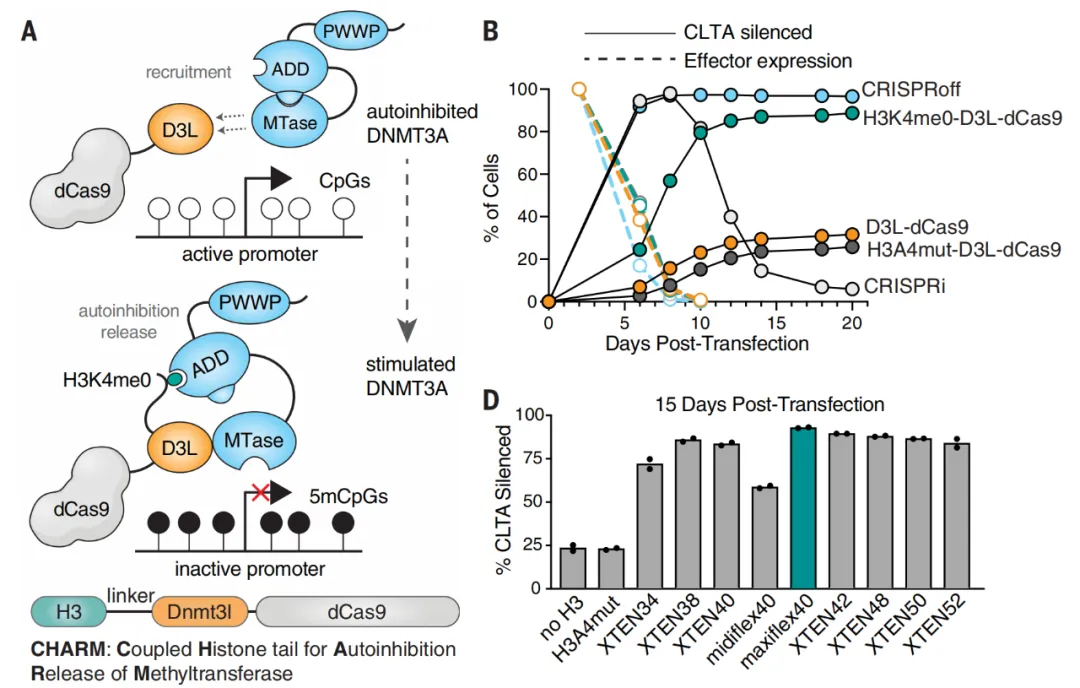
CHARM is an epigenetic editor for targeted DNA methylation and gene silencing. (Resource:DOI: 10.1126/science.ado708)
Adeno-associated virus (AAV) vectors are the preferred delivery vehicles for the central nervous system, offering advantages such as good safety, a wide host cell range, and long-term expression of transgenes in vivo.
Jonathan Weissman's team had previously developed a CRISPR-based epigenetic editor—CRISPRoff—which achieves gene silencing by adding methylation to the target gene without altering the DNA sequence, thereby inhibiting gene expression and protein production. The research team confirmed that this editor could effectively and stably suppress the expression of the prion protein gene.
However, CRISPRoff was too large for an AAV vector to carry, primarily because the Cas9 protein occupies too much space.
As a result, the research team began designing a novel epigenetic editor with a sufficiently small size to fit within a single AAV vector, enabling efficient delivery to the brain and effective action. The team considered zinc finger proteins (ZFP), which are much smaller than Cas9. Like Cas9, zinc finger proteins can serve as guide proteins to direct the editor to the target gene site. Additionally, ZFPs are common in human cells, making them less likely to trigger an immune response compared to Cas9 proteins derived from bacteria.
The zinc finger protein (ZFP)-based CHARM has a compact size that allows for the incorporation of up to three DNA-targeting elements in a single AAV vector, providing extra space for regulatory elements to confer cell-type specificity.
Further studies showed that when coupled with a zinc finger domain targeting the prion protein-encoding gene and delivered to the mouse brain via AAV, CHARM methylated the prion gene promoter, reducing prion protein expression in neurons throughout the entire mouse brain by 80%, far exceeding the minimum threshold required for therapeutic efficacy (previous studies have shown that eliminating just 21% of prion protein is sufficient to significantly improve symptoms).
Overall, the study published in Science developed a novel epigenetic editor—CHARM—that can programmably target and methylate DNA in the brain, effectively and persistently silencing the target gene. CHARM's compact size enables, for the first time, the delivery of an AAV-mediated epigenetic editor. Its modular design implements a self-silencing strategy, promotes multiplex targeting, and enhances compatibility with other delivery methods (such as LNPs).
Outlook
The journey from basic research to clinical trials is both lengthy and complex, and CHARM still has a considerable distance to travel before it can become a viable treatment for prion diseases. Nevertheless, with its solid therapeutic design and promising experimental results, the research team has ample reason to remain optimistic about the future.